Why blackout is the hottest trend in license plate design
Plus: This national flag was redesigned with endangered species for a campaign to protect marine areas

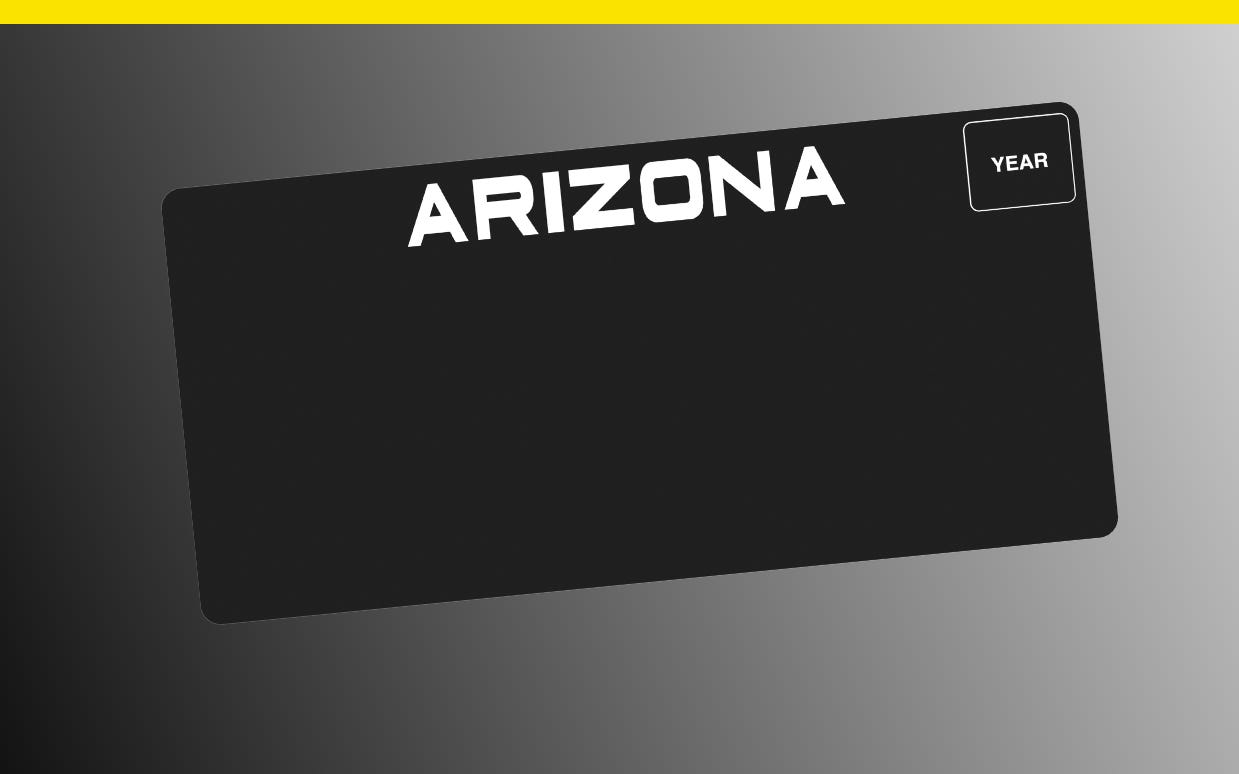
Arizona’s Department of Transportation offers specialty license plates for Alice Cooper, the Phoenix Suns, and Route 66, and starting last month, it rolled out a simple new blackout design to raise money for good causes.
A portion of the fees from specialty plates in Arizona go to charities or nonprofits. For most, it’s $17 for the initial plate, then $17 annually thereafter for renewal fees. Most charities do this with plate designs that include their branding, like the Girls Scouts trefoil or a four-leaf clover for 4-H. For 4AZKids, a plate that supports charities that help Arizona children, the plate is all black and super minimalist with no logo. The state name and license plate number are written in white.
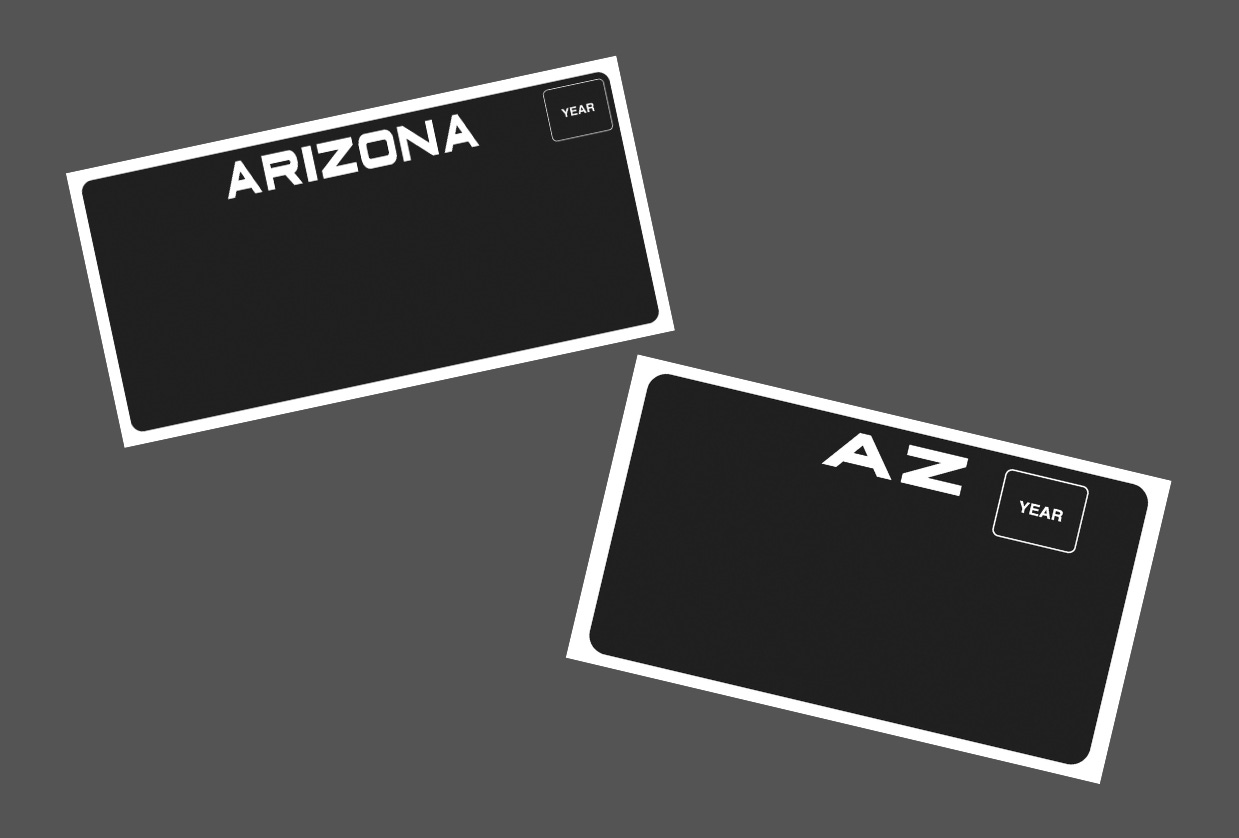
“Our goal is to raise as much as possible to support children’s charities in Arizona, and we believe we can do this by giving Arizona drivers what they want — a complete logo-free black plate,” Tad Crother, president of Saguaros, the group behind the plate, tells me. “We saw that all-black specialty license plates in other states are seeing huge sales numbers, and we wanted to capitalize on that demand here in Arizona.”
The group granted $750,000 to 29 nonprofits in 2025, he says, including Phoenix Children’s Hospital, Boys & Girls Clubs, and Arizona Cancer Foundation for Children. Crother says the money the plates raise has the potential to add a larger stream of funding for its work.
Blackout designs are growing in popularity across the country, but they’re actually a throwback to some of the earliest license plates in the U.S. In Delaware, the first state, its first license plates issued in 1909 was a white-on-black porcelain plate, while other states had their own early, simple, two-color plates.
License plate design started changing 50 years ago around the bicentennial as states put out red, white, and blue specialty plates for the occasion, then a specialty California license plate for the 1984 Los Angeles Olympics popularized the idea of a specialty plate for an event or group outside of veterans or the disabled, says Jeff Minerd, of the Automobile License Plate Collectors Association.
“Now, you know, there's everything,” he tells me.
As license plate design has grown more complex, the trend towards blackout plates or other minimalist, two-color scheme designs has caught on like a reaction against maximalism. Also they just look cool.
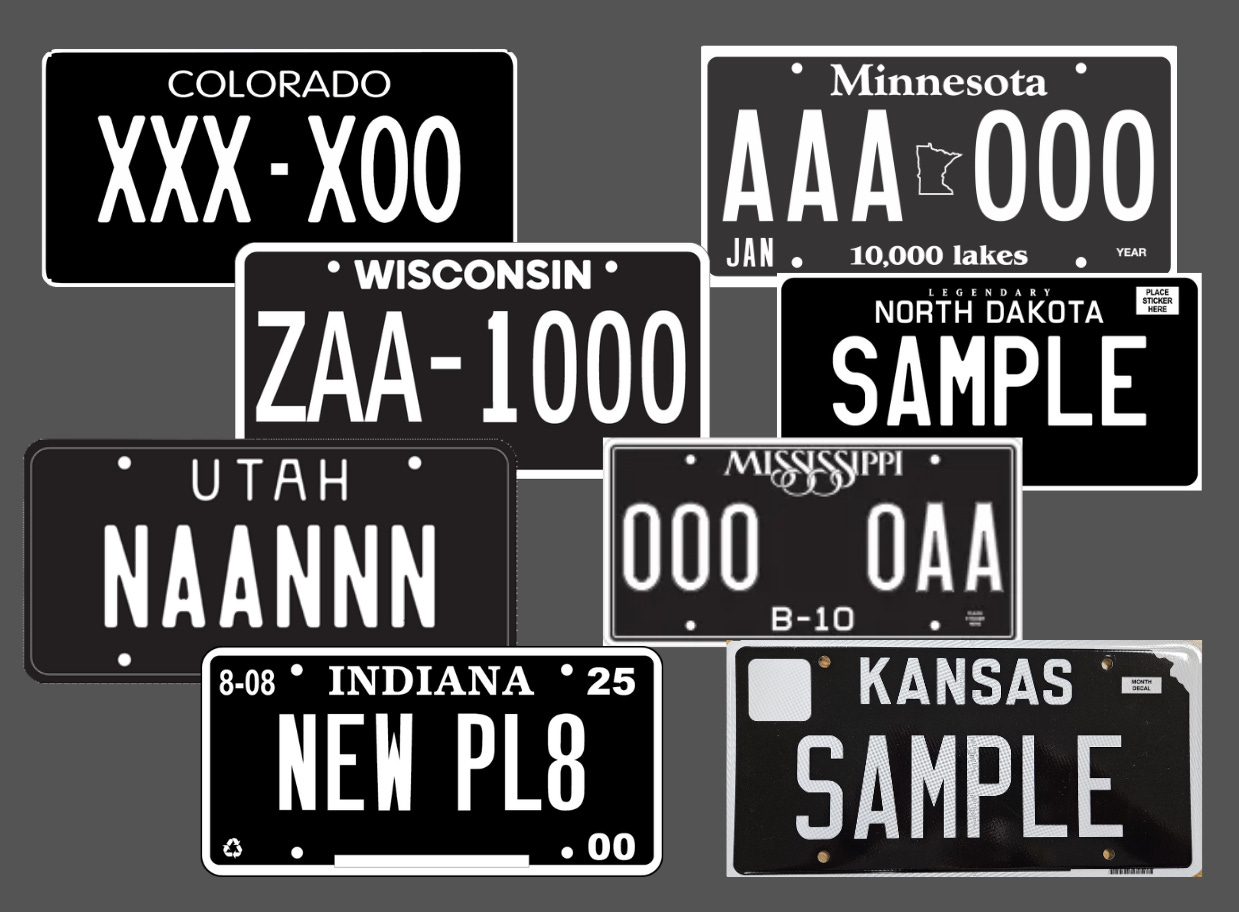
Colorado released simple black, red, and blue license plates in 2023 as a throwback to some of its own vintage designs, and the blackout plate became the most popular speciality plate in the state in its first month of its release. In Utah, blackout plates first released in 2023 to raise money for the Utah State Historical Society were so popular that lawmakers in March doubled the price to split the proceeds into three funds, including a grant fund for Olympic and Paralympic venues. Indiana, Kansas, Kentucky, and North Dakota all released their own black plates last year, and if your state doesn’t have one yet, don’t be surprised if it does soon.
In Arizona, the Saguaros’s blackout 4AZKids plate isn’t the only new license plate to go minimalist. New license plates for the Gila River Indian Community, No One Fights Alone to raise funds for mental wellness for first responders, military, veterans, and their families, and Teen Lifeline, for teen suicide prevention, are all black except for a seal or logos. And the groups Executive Council Charities and Empower Coalition also have their own blackout plates, but with text in red or blue, respectively, in order to fund grants for youth programs and veterans and military families.
Branding is great, but sometimes unbranding is better. Arizona’s blackout plate shows the best results don’t always come with a logo.



This national flag was redesigned with endangered species for a campaign to protect marine areas
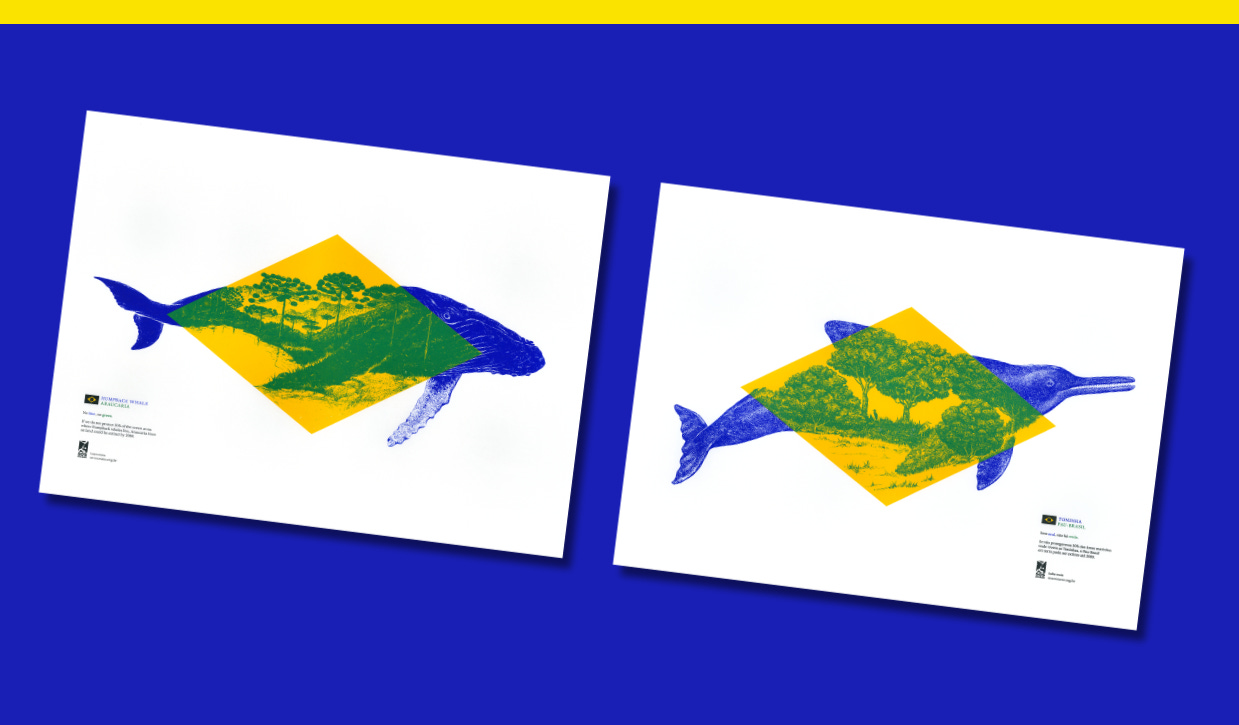
Brazil is home to both the world’s largest forest, the Amazon rainforest, as well as the world’s longest beach, Praia do Cassino, but the forest is much better known. A new multi-part campaign is aimed at drawing public attention to Brazil’s coastlines and ocean by remaking the country’s flag with endangered flora and marine life.
“People don’t talk so much about the oceans,” Diego Limberti, chief design officer at the creative agency Droga5 São Paulo tells me, but one depends on the other since oceans influence global weather patterns and climate. “If you don’t have oceans, you don’t have forests.”
To make that connection more apparent, Droga5 São Paulo worked on a “No Blue, No Green” campaign for SOS Oceano, a group of non-governmental organizations, or NGOs, that advocate for expanding marine-protected areas in Brazil. The campaign is all about the colors of Brazil’s green, yellow, and blue flag. The first phase blacked out the blue and green from the flag to convey environmental loss. The second phase takes a different approach by combining blue and yellow to get green on screen prints that cleverly mash-up images of endangered species to make a point.
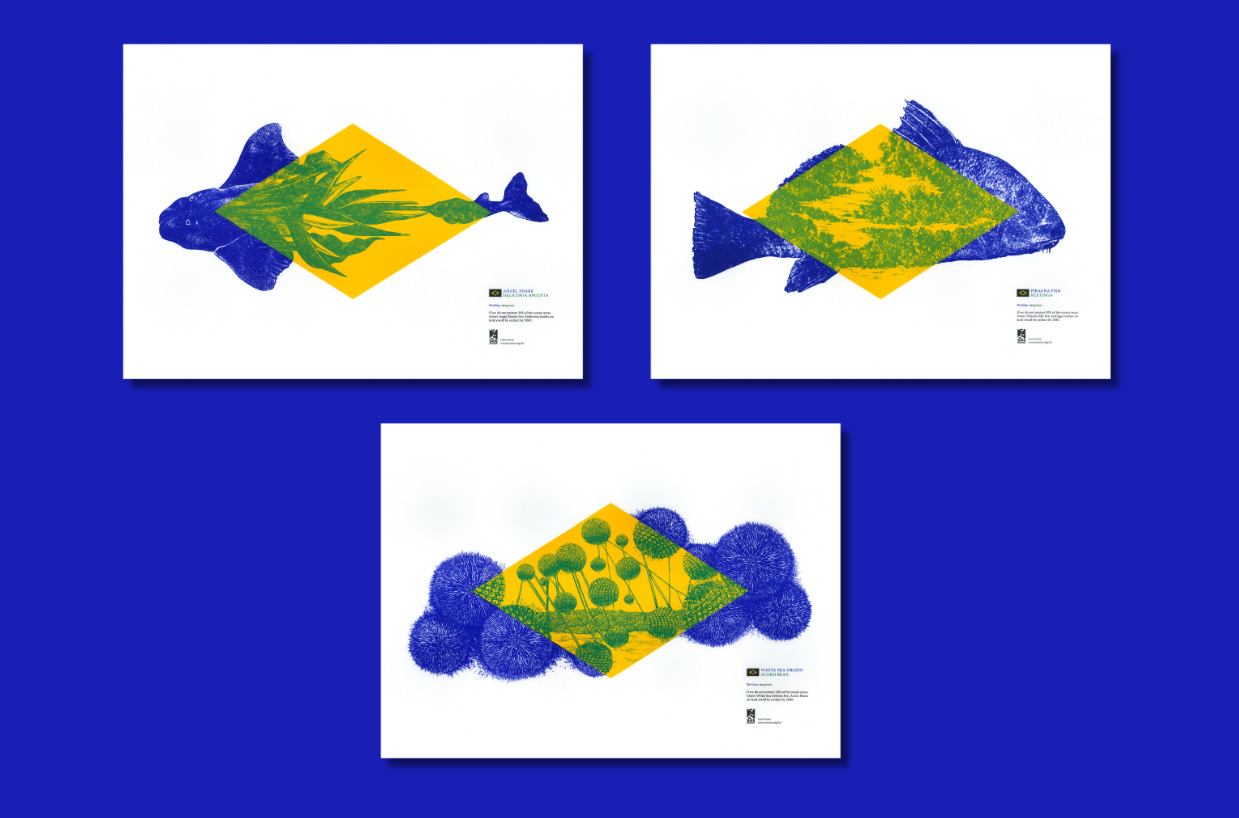
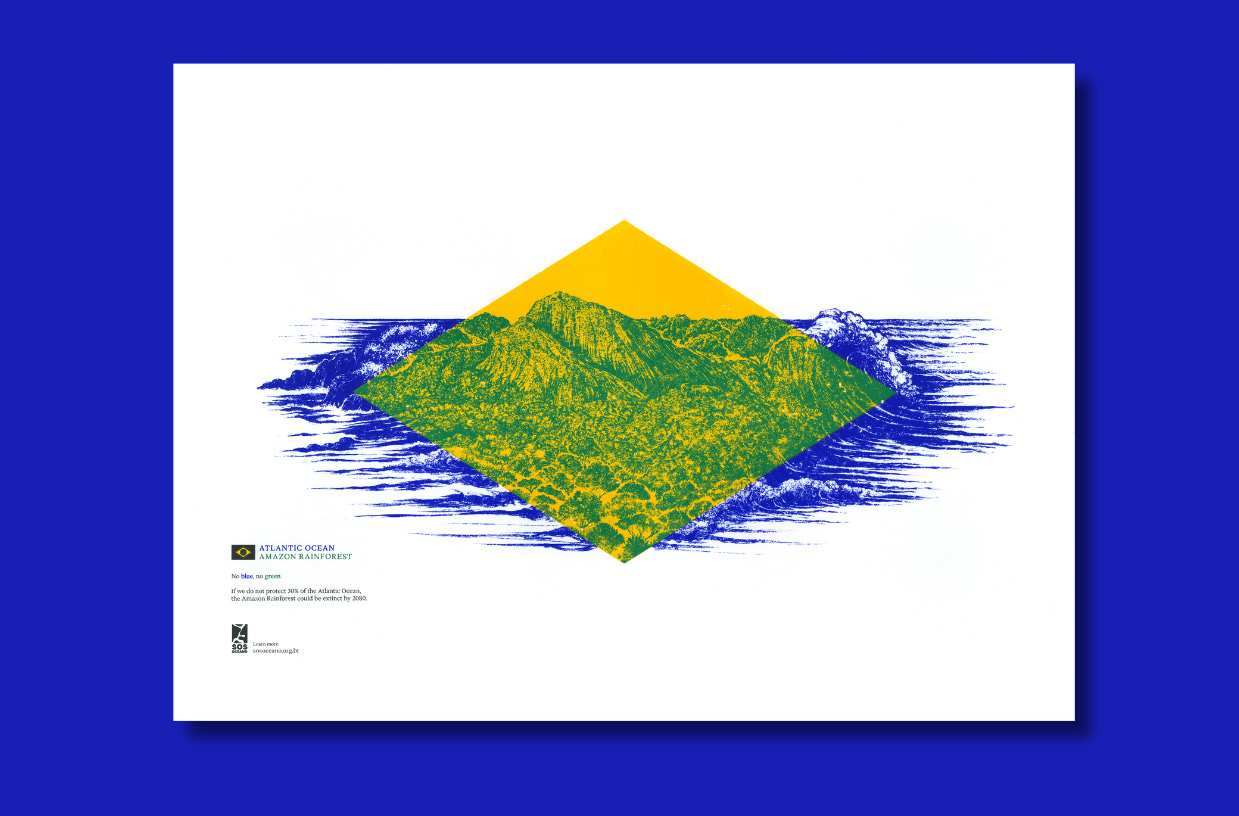
The flag designs show endangered marine species in blue, and the yellow diamond-shaped lozenge on the center of Brazil’s flag is stamped in the middle where it usually goes. A corresponding forest scene in green completes the image by mixing two primary colors to get a secondary color.
The idea is to show the link between living things, like a humpback whale and Araucaria trees that are paired in one of the screenprints, or a piraña fish and restingas, a bush, in another. If we don’t protect the ocean areas where marine life lives, plants on land could go extinct too, the graphics explain. The goal is to show “how one biome depends on another biome,” Limberti says.
A total of six flags were created, including one that shows an Amazon rainforest scene stamped over Atlantic Ocean waves, while others were made to correspond with different regions of Brazil. Designers worked with biologists who identified the most endangered species from different regions to depict, and each was made using natural mineral pigments developed with Black Madre Studio and Joules & Joules Laboratory.
“The project is rooted in color theory,” Black Madre Studio creative director André Maciel said in a statement. “When we say ‘without blue there is no green,’ we’re working with the fundamental logic of primary and secondary colors: blue and yellow create green.”
Helpfully for Brazil’s environmental advocates, the country’s flag’s colors offer widely recognized symbolism when it comes to visually communicating the planet, both the oceans and land. “No Blue, No Green” uses color to reinforce that message in a simple but clever way.
Have you seen this?
Messages to America. Every former living U.S. president said their message to America in an interview with a former first daughter at an event for everyone’s dad’s favorite channel, the History Channel. Plus: Madonna announced Confessions II in the best way. [Whig by Hunter Schwarz]
Hundreds of pro-Trump avatars emerge on social media. The artificial-intelligence-generated fake influencers have surged on TikTok, Instagram, Facebook, and YouTube in an apparent bid to hook conservative voters. [The New York Times]
NASA’s Artemis logo has a deep message you probably didn’t notice. The A makes an arrow that points beyond the moon. [Creativebloq]

Democratic primary challengers stockpile cash, putting House incumbents on defense. At least nine House Democrats and one Democratic senator, Ed Markey of Massachusetts, were outraised by their primary challengers in the first fundraising quarter of the year. [NBC News]
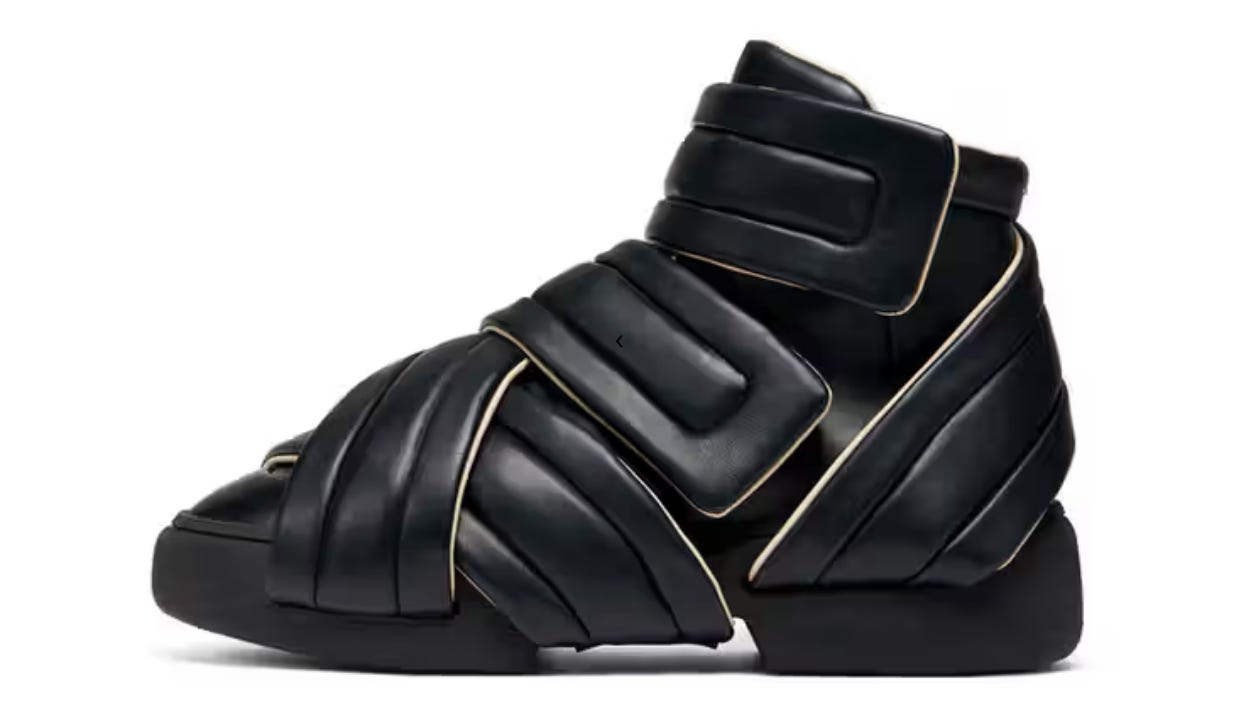
Maison Margiela’s “Future” sneaker returns strapped more than before. Originally introduced in the SS11 collection, the subversive mid-top silhouette makes a dramatic comeback. [Hypebeast]