The only baseball team owned by a future president branded its new uniforms for bilateralism
Plus: Nearly a quarter of Trump’s proposed arch height is just statue

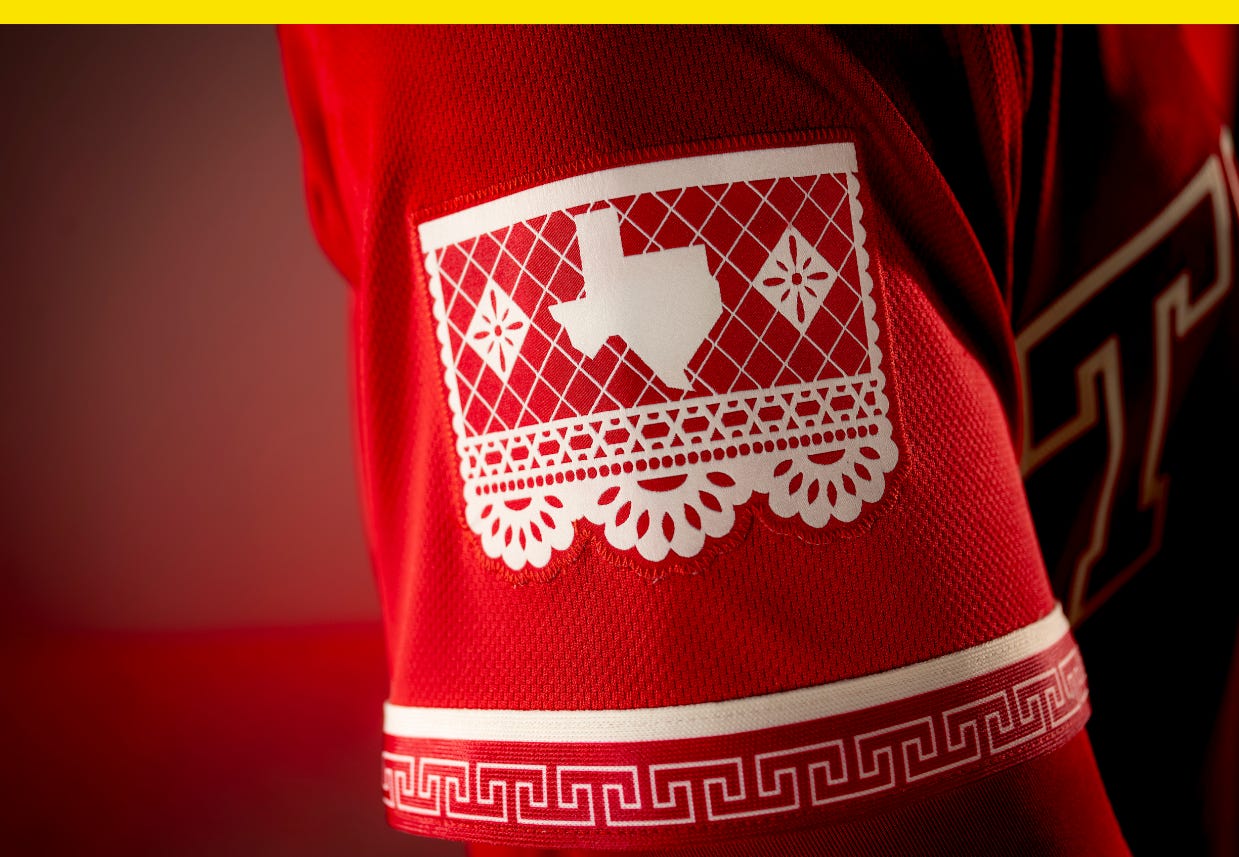
For its 2026 MLB City Connect uniform, the Texas Rangers looked to influences from south of the border for inspiration. The Rangers announced their special-edition City Connect uniforms with Nike Thursday that the team says are meant to celebrate “the Mexican influences across the entire state of Texas.”
Hispanic Texans today make up roughly 40% of the state, which was famously once part of Mexico before declaring its independence and then joining the Union. With the new uniforms, the only MLB team ever owned by a future U.S. president (former President George W. Bush had an ownership stake in the team from 1989 to 1998) is paying homage to state and team history while reaching out to the largest demographic group in Texas.
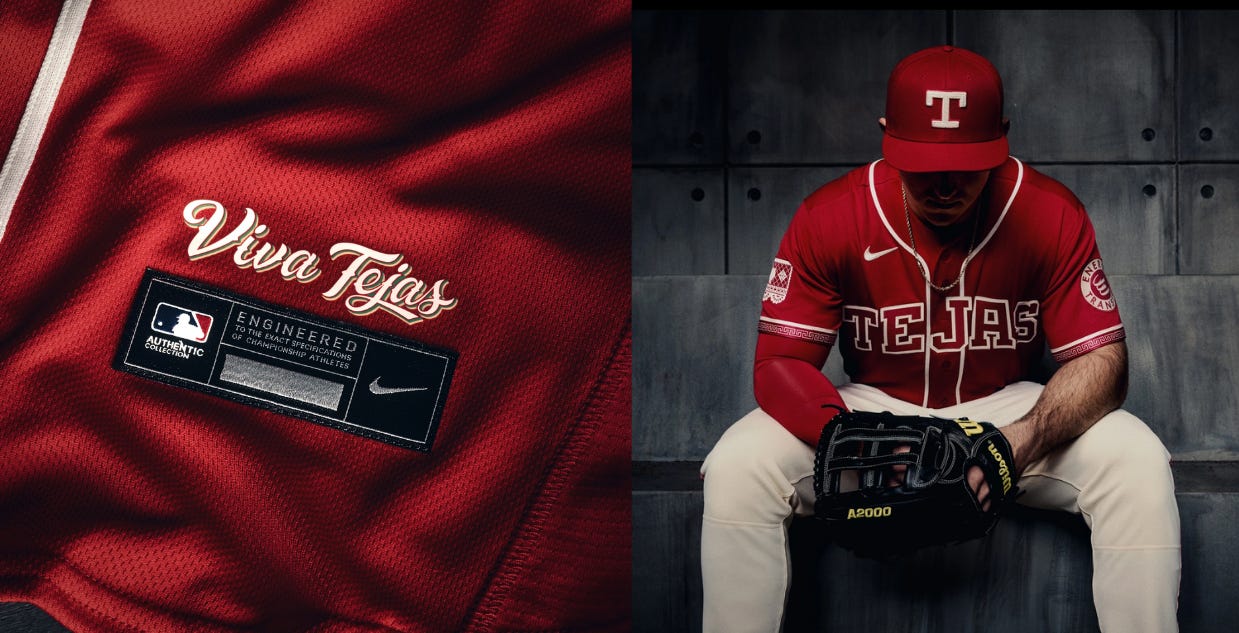
The new “Viva Tejas” uniforms, for “Long Live Texas,” uses the state’s Spanish-language name on the front, while the bright red color of the jersey was chosen to match the color of a crimson dye made from cochineal insects, the oldest pigment in the Americas. There’s a Charro-style pattern around the sleeve inspired by the embroidery used by Mexican horsemen, and on the left sleeve, there’s a Texas map decal designed in the style of Mexican papal picado, or tissue paper art.
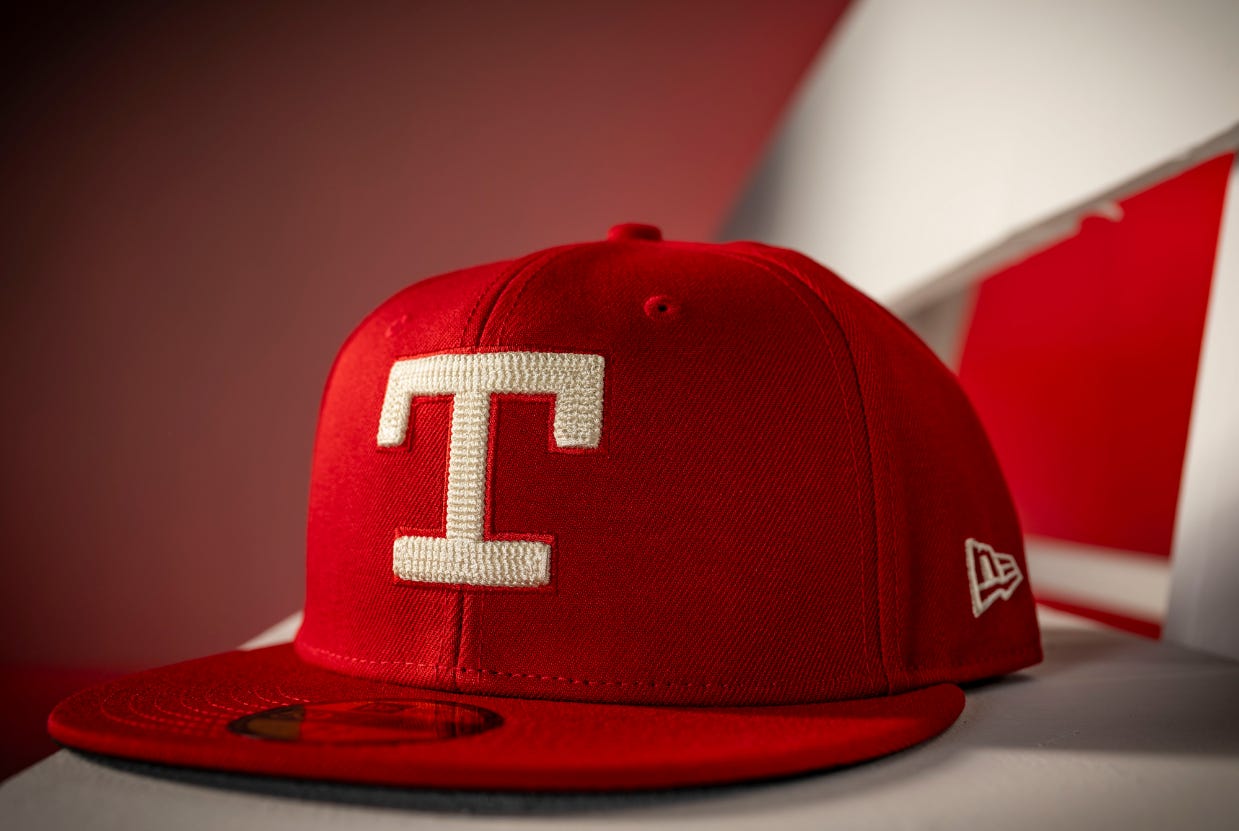
The blocky, athletic-style typeface on the jersey was designed as an update on the team’s 1980s uniforms typography, while the T on the ball caps is from the team’s original uniforms after relocating to Texas in 1972.
“Nike’s theme for us was reimagining tradition,” Travis Dillon, Rangers senior vice president of marketing, said in a statement. And in celebrating the state’s Hispanic heritage through design, it’s part of what Dillon described as a longer-running effort “to build what we think is an authentic and reciprocal relationship with our Hispanic fans.”
Major League Baseball introduced City Connect uniforms in 2021 as an initiative to commemorate teams’ local history and culture in creative ways with alternative uniforms that might otherwise clash with the official team brand guide. While it’s led to some fun, alternative jerseys, there have also been a lot of clunkers. The Milwaukee Brewers “Wisco” uniforms this year are corny, and no shade, but I thought the bisexual gradient Kansas City Royals uniforms were for Pride. GQ announced this week “It’s Time to Kill the MLB City Connect Jerseys” because they’re “youth-travel-ball-ass getups.”
Designers for the Rangers, though, hit a grand slam with a uniform that manages to teach a mini social studies lesson without being lame and fitting within the team’s visual brand universe while also establishing what could become a long-running alternative visual identity.
In 2005, San Francisco Giants wore “Gigantes” jerseys to honor Hall of Famer Juan Marichal, a Dominican Hall of Famer, while the Milwaukee Brewers debuted an alternative “Cerveceros” brand that year for “Cerveceros Day” to celebrate Latin American culture. Since then, other teams have added their own alternative Hispanic heritage brands. While these brands serve as marketing tools, they’ve been used before to make a political statement too.
After Arizona passed a strict, controversial immigration law in 2010, Phoenix’s NBA team wore “Los Suns” jerseys in protest on Cinco de Mayo during the Western Conference Semifinals. Steve Nash called the law “misguided” and a “detriment to our society and our civil liberties” and Amare Stoudamire said he wore the uniforms “to let the Latin community know we're behind them 100%.” The “Los Suns” brand has lasted more than a decade, and the team released “Noche Los Suns City Edition” jerseys in black in 2019.
The rollout of the Spanish-language Rangers uniform isn’t tied to protest, but to come following President Donald Trump’s ramp up in deportations and his administration’s white washing of U.S. history through the levers of the state on things like coins and national parks, it’s a reminder that sports has a unique ability to promote inclusion and diversity through the power of its example. “Texas” is a Native word for friend or ally. Viva Tejas.



Nearly a quarter of Trump’s proposed arch height is statue
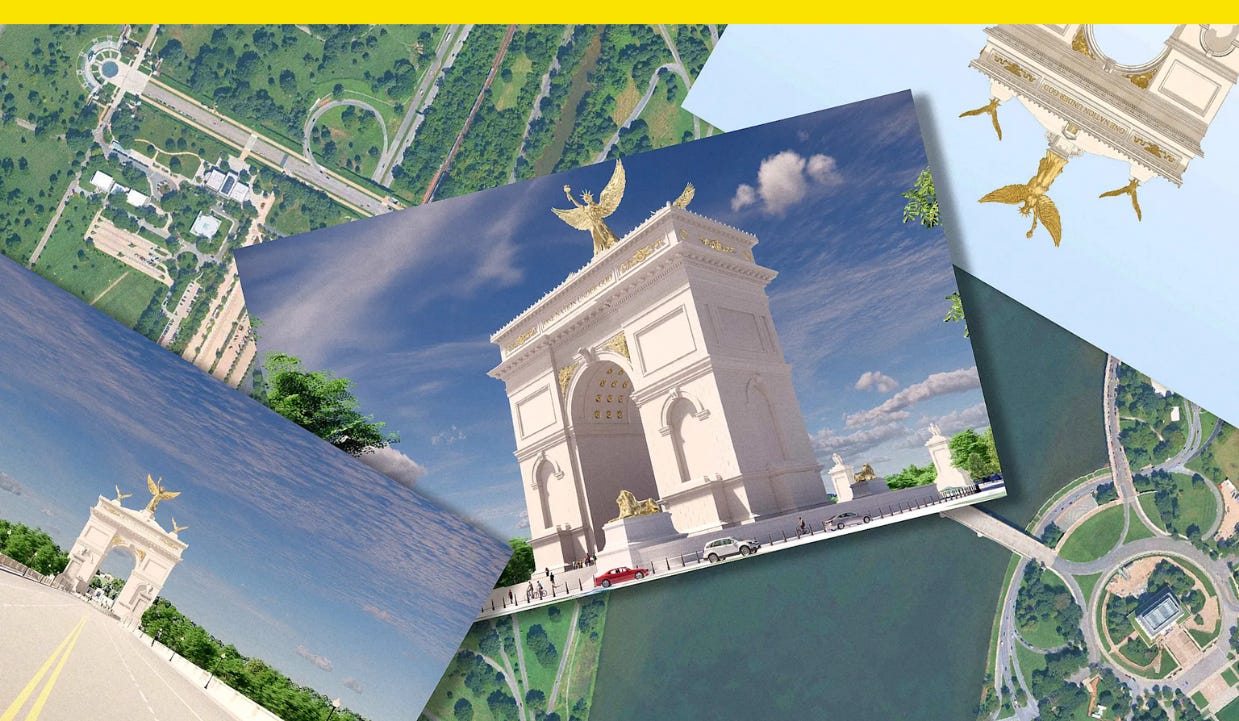
For months, President Donald Trump has shown off various prototypes of an arch monument he wants to build in Washington, D.C., and finally he’s landed on a concept: an extra-tall “Triumphal Arch” that he hopes will soon rise just outside Arlington National Cemetery overlooking the National Mall. Nearly a quarter of the arch’s 250-foot height is thanks to a gilded statue on top.
The Trump administration submitted renderings for the massive arch to the president’s handpicked Commission of Fine Arts on April 17. The renderings by Harrison Design, an architecture, interiors, and landscapes firm, show an arch and park that would stand in a roundabout between the cemetery and the Lincoln Memorial.
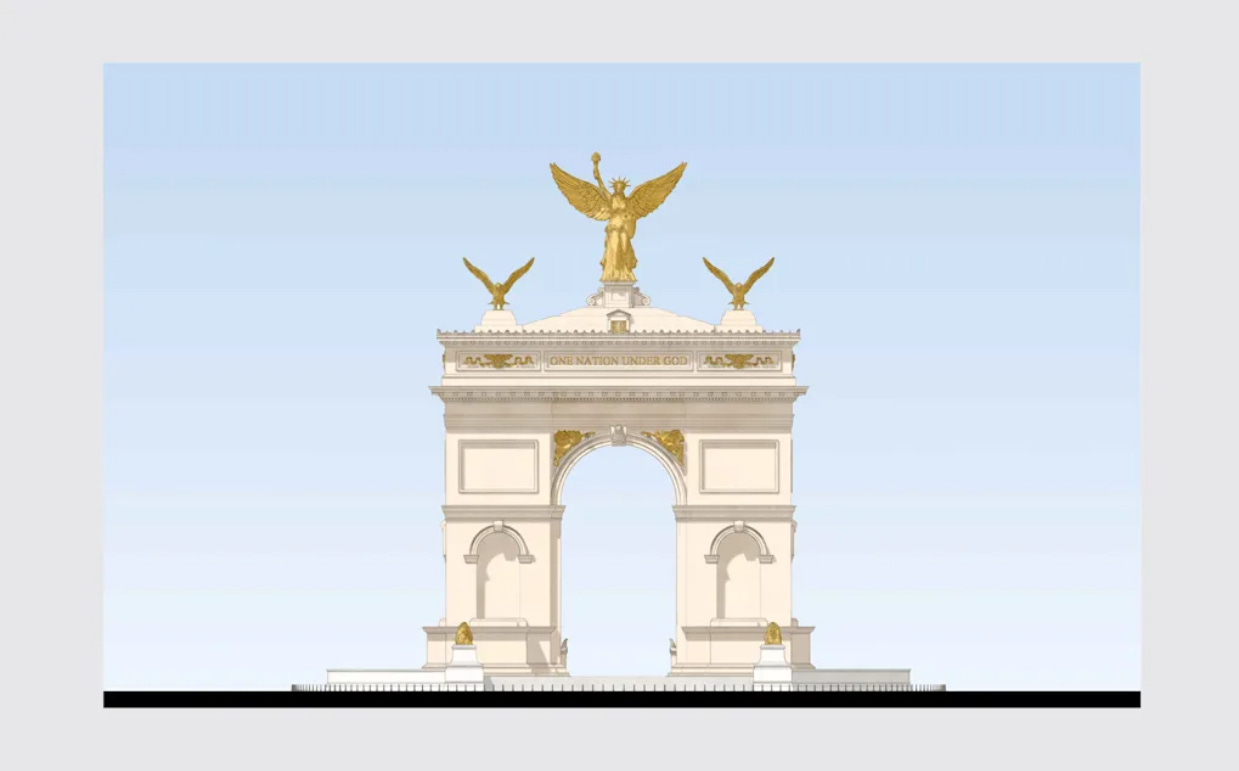
The design carries some of the hallmarks of Trump’s second-term federal buildings initiative with its oversize, gold-accented classical architecture, which would look right at home at Mar-a-Lago. Harrison Design did not respond to a request for comment.
The height of the arch is a hat tip to the semiquincentennial anniversary of the nation’s founding, which will be celebrated in July. But like a skyscraper that adds a spire or antenna for a few extra feet, it gets there with some help from its ornamentation: a 60-foot winged Lady Liberty-like gold statue flanked by gold bald eagles. The rendering also shows gilded lions at the base and the phrases “ONE NATION UNDER GOD” and “LIBERTY AND JUSTICE FOR ALL” inscribed on either side.
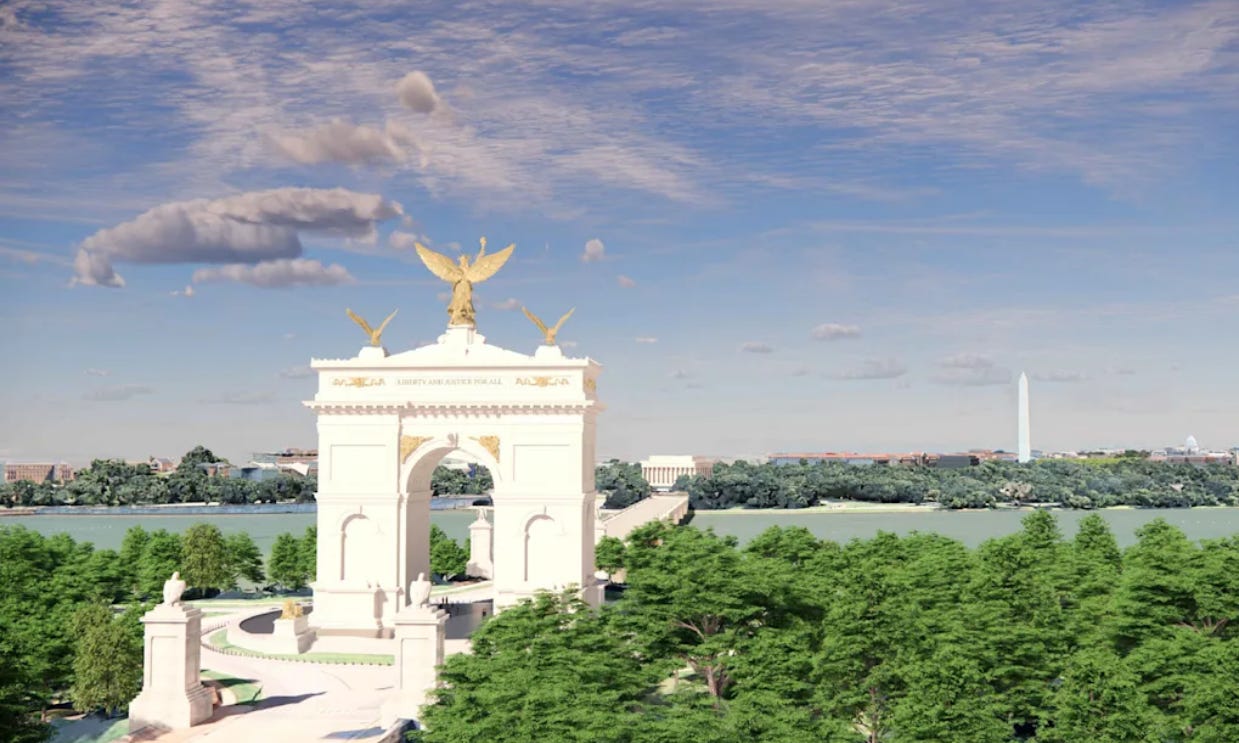
Trump wrote in an April 10 post on his social network that the structure would be “the GREATEST and MOST BEAUTIFUL Triumphal Arch, anywhere in the World. This will be a wonderful addition to the Washington, D.C. area for all Americans to enjoy for many decades to come!” Though he said the arch would be completed by Independence Day, construction hasn’t started.
Trump’s planned arch would tower above the 99-foot-tall Lincoln Memorial on the other side of the Potomac River. Architecture critic Catesby Leigh, who supports the idea of an arch monument in D.C. like those found in other Western capital cities like Paris, nevertheless told PBS that Trump’s proposal is “way out of scale” and “way too big.” Sue Mobley, director of research at the nonprofit public art studio Monument Lab, calls it “banal.”
“I believe it is traditional to have some sort of victory prior to erecting a triumphal arch,” Mobley tells me. “That said, one of the more exhausting traditions of authoritarians is to perform victory out of a loss, and to imagine that the aesthetic will overwrite the actual.”
As with Trump’s push to build a massive White House ballroom and add his name to any number of prominent structures, from the Kennedy Center to New York’s Penn Station, his proposal to build an arch has also drawn fierce scrutiny and lawsuits. Demonstrators marched on the site of the proposed arch during last month’s No Kings protest, and a group of Vietnam War veterans accused Trump of not getting the proper congressional approvals to build the arch in a suit filed in February by the watchdog group Public Citizen.
In their court filing, attorneys for the veterans said the arch, which would be roughly as tall as an 18- to 25-story office building, would obstruct “a line of sight” between Arlington National Cemetery and the Lincoln Memorial “that was designed to represent the unification of the Nation following the Civil War and that has existed for nearly a century.” The filing further states that the plaintiffs believe the structure would “dishonor their military and foreign service and the legacy of their comrades and other veterans buried at Arlington National Cemetery, and would degrade their personal experience when visiting Arlington Cemetery.”
Trump announced his plans for an arch last year, but if pushback to the project is anything like pushback to his ballroom, there could still be hurdles. A federal judge halted construction of the ballroom earlier this month.
This story was first published in Fast Company.
Have you seen this?
DoorDashing to 1600 Pennsylvania Ave. In an historic first, Trump got McDonald’s DoorDashed to the White House after deleting a sacrilegious social media post, and when he asked his delivery driver Sharon Simmons if she voted for him, all she could say was “maybe.” [Whig by Hunter Schwarz]
The brand tightrope of the summer: How to make a patriotic sales pitch for America250 that won’t make anyone mad. Brands are gearing up for America’s 250th birthday celebration. But invoking an all-inclusive patriotism that doesn’t alienate anyone in 2026 is a fine line to walk. [Fast Company]
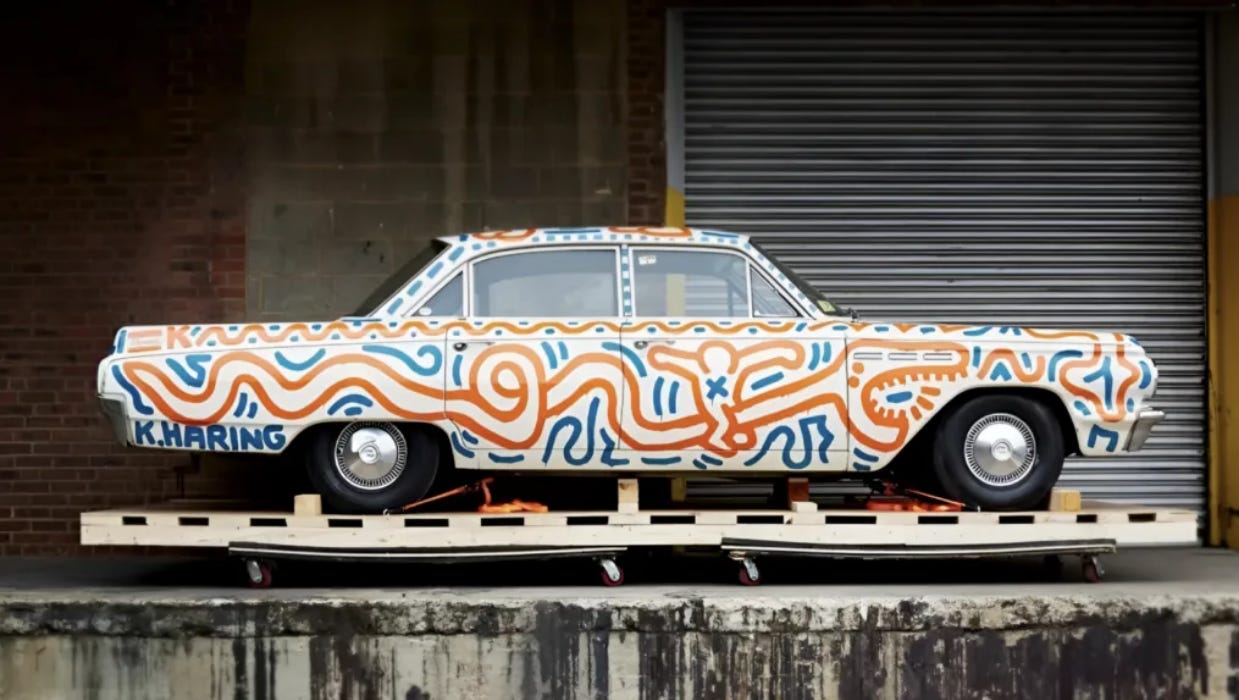
Two of Keith Haring’s painted cars roll into New York for the first time. The vehicles' outing marks the release of the new book, "Keith Haring in 3D." [Artnet News]
Postal Service union launches ad campaign promoting mail voting as Trump assails the method. A major U.S. Postal Service union is launching a national TV ad campaign promoting voting by mail, stepping into a politically charged debate as skepticism about mail-in ballots has been raised by Trump and others. [Associated Press]
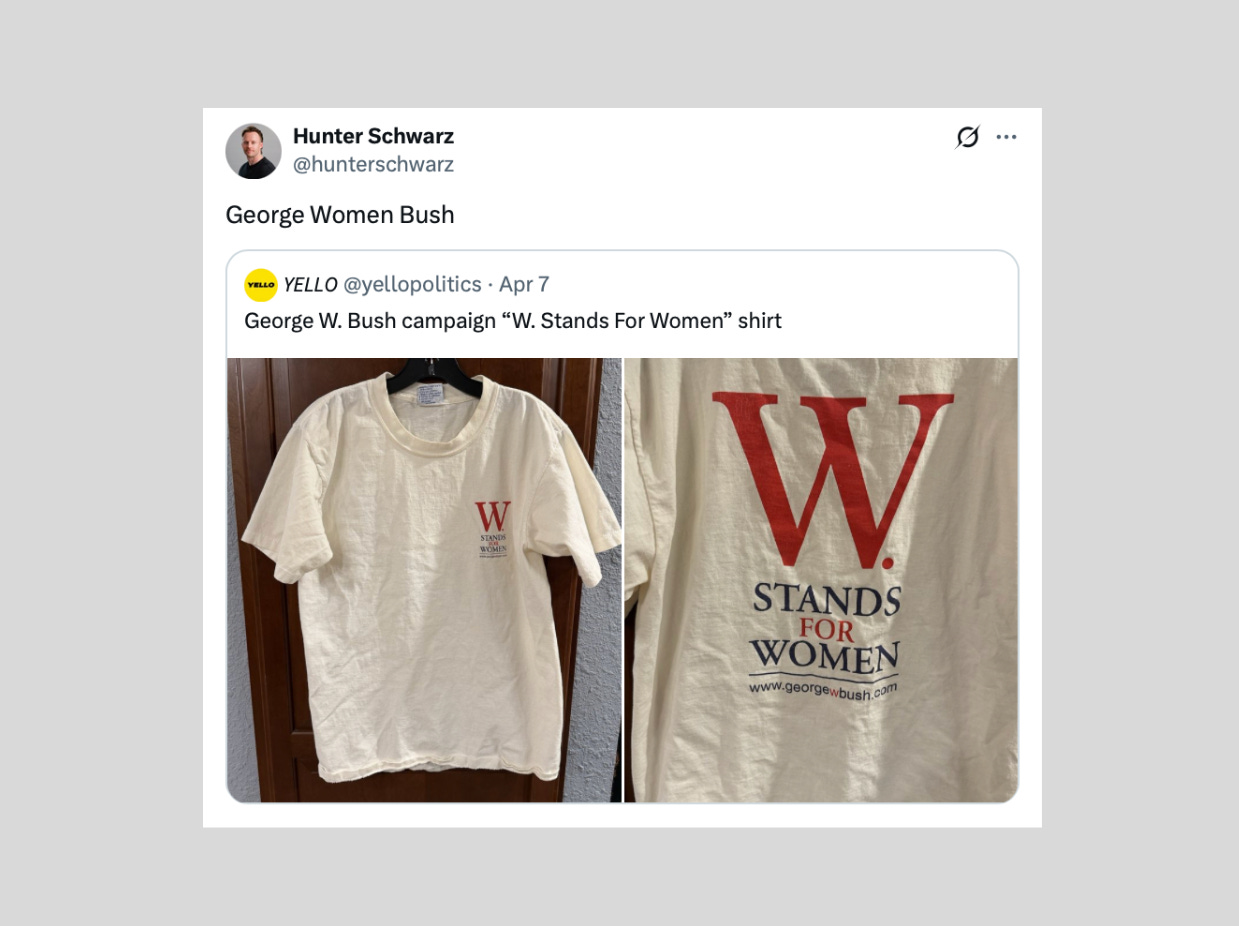
George W. Bush’s presidential campaigns used “W. Stands for Women” branding as part of its outreach to female voters. And his father was called George Herbert Women Bush. [hunterschwarz/X]