
For politicians, what's the line between PSA and political ad?
Plus: The bald eagle in the new dime was designed without olive branches for peace. Here’s what the artist says.


After a former New York governor spent roughly $20 million in state funds on ads he starred in, lawmakers there passed a law banning the practice. Nearly 20 years later, two elected officials have found creative loopholes at a time when the lines between public service announcements and political ads funded by taxpayers in the U.S. can seem as blurred as ever.
New York’s former Republican Gov. George Pataki appeared in five ads paid for by city agencies in 2000 promoting things like children’s health care and energy conservation, the New York Times reported at the time. Seven years later, a public officers law was passed prohibiting “advertisements by elected government officials and candidates made with public funds” to make sure it couldn’t happen again. There appears to be a few ways around it, though.
New York’s Democratic Gov. Kathy Hochul and New York City Mayor Mamdani make appearances in new campaigns this year promoting her administration’s homebuilding agenda and his city’s pre-K enrollment, respectively. Hochul doesn’t directly appear in her ads, but the ads do point to a state-run site where she’s prominently featured, and a state Republican Assemblymember characterized it as skirting the intent of the law.
For Mamdani, whose spot promoting pre-K enrollment was shot to look like a classroom and appears on LinkNYC kiosks and on TaxiTV, the loophole is that no public funds are being spent to run the ads, as the city is given free monthly screen time on the kiosks and screens.
Public officials using their office to nab some screen time isn’t a new phenomenon. In 1972, then-California Gov. Ronald Reagan appeared in PSA for state’s Office of Traffic Safety alongside Joe Higgins, a character actor, who played an officer stopping him for a vehicle inspection. But it has been taken to new extremes.
Before she was fired earlier this month, outgoing Homeland Security Secretary Kristi Noem starred in an incredible $220 million worth of ads thanking President Donald Trump and calling on people in the country illegally to self deport. It was the most expensive political ad of 2025, Axios found, while two years ago in Florida, a pair of ballot measures that Republican Gov. Ron DeSantis opposed about marijuana and abortion faced $50 million in state-funded ads and were defeated.
“There is a fine line between political promotion and policy promotion,” Brandon Rottinghaus, a political science professor at the University of Houston who’s researched public opinion and political communication, tells me in an email. “Politicians walk it all the time.”
At the national level, the Hatch Act is meant to prohibit federal employees from using their jobs for political activities, though it’s rarely enforced and frequently ignored, he says. At the state level in New York, its Commission on Ethics and Lobbying in Government adds teeth to enforcement when it matters most. The commission can fine any public official who intentionally appears in a PSA within 90 days on an election, even if it’s about worthy causes like breast cancer screenings, disaster relief, or domestic violence awareness.
In Congress, taxpayer-funded ads are seemingly baked into the job. Franking, which allows lawmakers to send mail without postage, is meant to allow members of Congress to communicate with their constituents, but all too often, this communication appears overtly political and can give incumbents an advantage. Data from AdImpact found House members spent $5 million during the 2024 campaign cycle on broadcast and digital ads through their franking privilege, according to Punchbowl News.
Rottinghaus says to restore trust in government and help separate the public from the political, more robust monitoring would help, but he notes that these days, everything can feel political, so it’s hard to disentangle official policy promotions for the public good and overt political advertising.
“It’s possible the truth is in the eye of the beholder,” he says. “Neutrality is the watchword for policy promotion. Politicians should be careful to strain the politics out of the promotional process as much as possible.”
The Freedom 250 Grand Prix will bring street racing to Washington D.C.
The circuit looks like a video game.
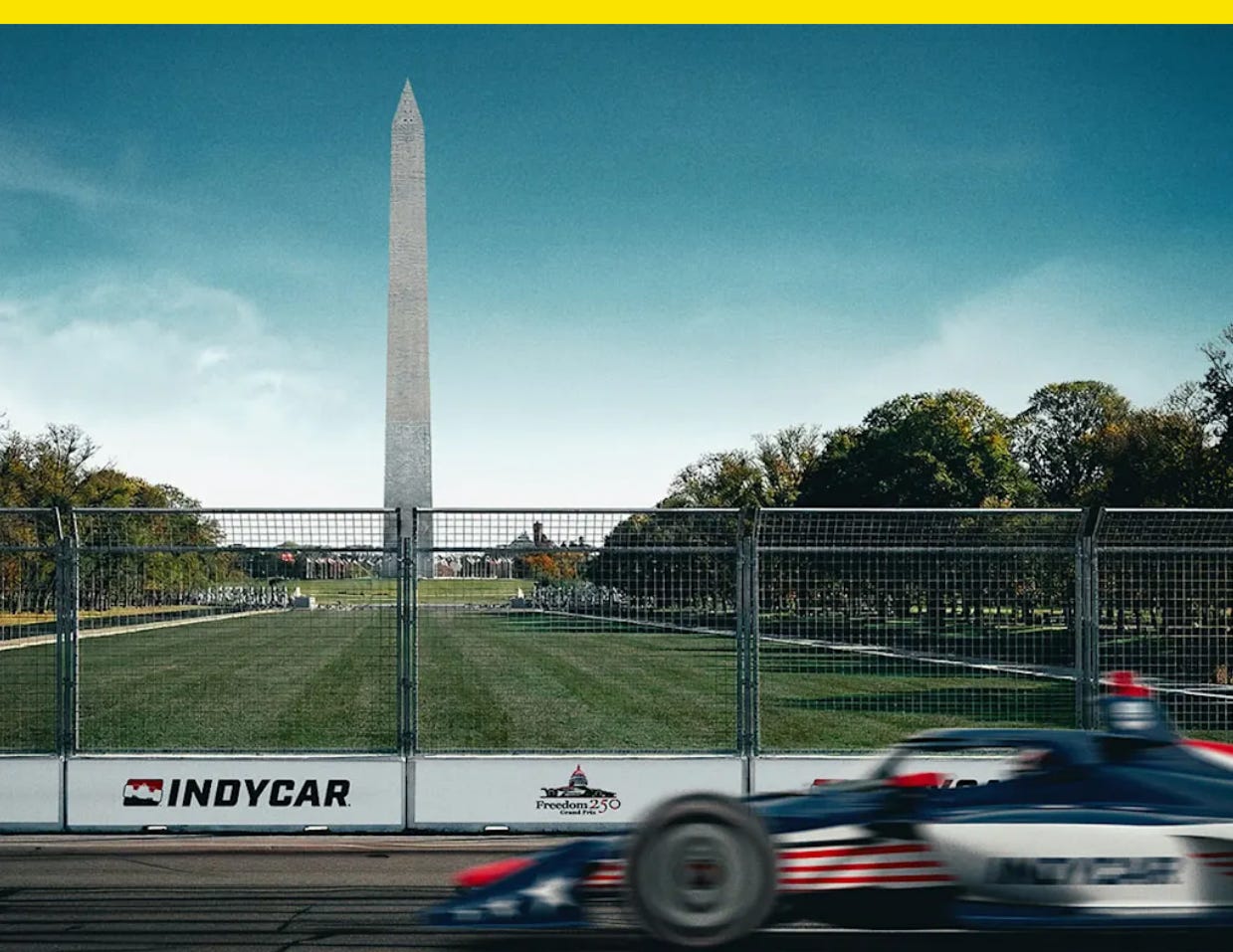
The route for the Freedom 250 Grand Prix, the first-ever street race on the National Mall in Washington, D.C., planned for August, was drawn to pass as many tourist attractions as possible in a part of town that’s dense with them.
In renderings, the route looks like something out of a race car arcade game, with cars whizzing past unmistakable U.S. monuments and Smithsonian museums. It’s an unlikely sight for a city whose standard speed limit is 20 mph (NNT IndyCar Series cars can reach speeds exceeding 200 miles per hour).
The 1.7-mile circuit opens with a front stretch along Pennsylvania Avenue by the U.S. Capitol and heads northwest past the National Gallery of Art and Canada’s U.S. Embassy where cars can get the most speed.
The circuit then takes a sharp left turn after the National Archives and cuts south through the National Mall at 7th Street, giving viewers there backdrops of race featuring the Capitol or the Washington Monument.
After passing between the Hirshhorn Museum and the Smithsonian Air and Space Museum, it then takes a left at Independence Avenue and heads back towards the Capitol. The pit lane is located on Pennsylvania Avenue.
“The circuit is unlike any other street race we’ve seen,” back-to-back Indianapolis 500 winner Josef Newgarden said in a statement after touring it Monday. “Racing through the heart of American history, with those amazing landmarks lining the course, is going to be incredibly powerful.”

The route was announced last week by NNT IndyCar Series, the open-wheel car racing body that runs the Indianapolis 500. The race is being put on in partnership with Monumental Sports & Entertainment, which owns the region’s NBA, NHL, and WNBA teams, and will be aired nationally live on Fox.
Open-wheel racing has found new audiences in the U.S. with the growing popularity of F1, while the Las Vegas Grand Prix, first held in 2023, showed the possibilities of street circuit in an iconic U.S. city with recognizable landmarks. Whereas the Las Vegas race was closed from public view, in D.C., the Freedom 250 Grand Prix will be open for anyone to watch, fitting for a race in which cars will zoom between Smithsonian museums famously known for their free admission.
The bald eagle in the new dime was designed without olive branches for peace. Here’s what the artist says.
The limited-time dime will be replaced again next year.
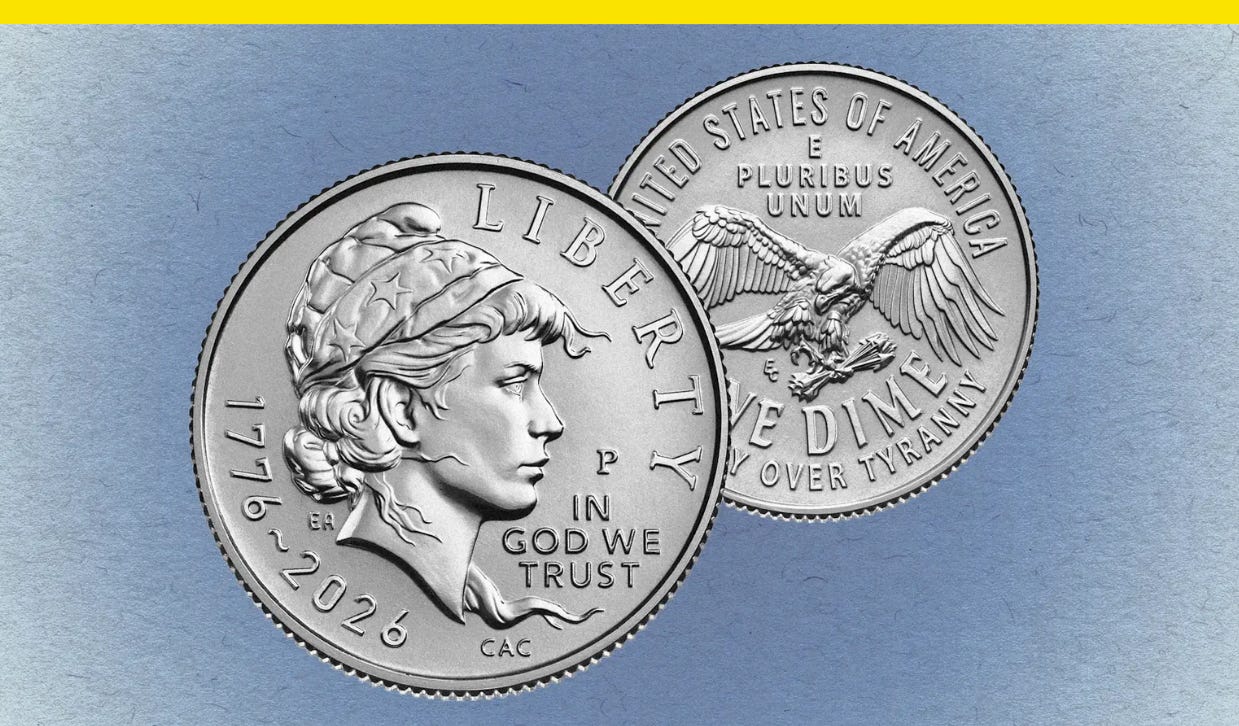
A limited-time dime design that the U.S. Mint is releasing this year is drawing attention over a very symbolic omission. The Emerging Liberty dime, created for the U.S. semiquincentennial, shows a woman who personifies liberty on the heads side; on the tails side, there’s a bald eagle holding arrows in its talons for war, but it’s missing olive branches in its other talons for peace.
The coin design was announced late last year, but those missing olive branches seem especially glaring as the Iran war enters its third week.
During his presidency, Trump has used the Mint to make a statement about his priorities. The administration has been trying to put Trump’s visage on a commemorative $1 coin, despite a U.S. law barring living former and current presidents from appearing on coins. Meanwhile, the four-year American Women Quarters program ended last year and wasn’t renewed. Trump’s Mint also scrapped plans from the Biden administration for commemorative 2026 coin designs that would have depicted advancements in civil and voting rights in U.S. history. Instead, the coin designs will focus on the U.S. founding and the American Revolution.
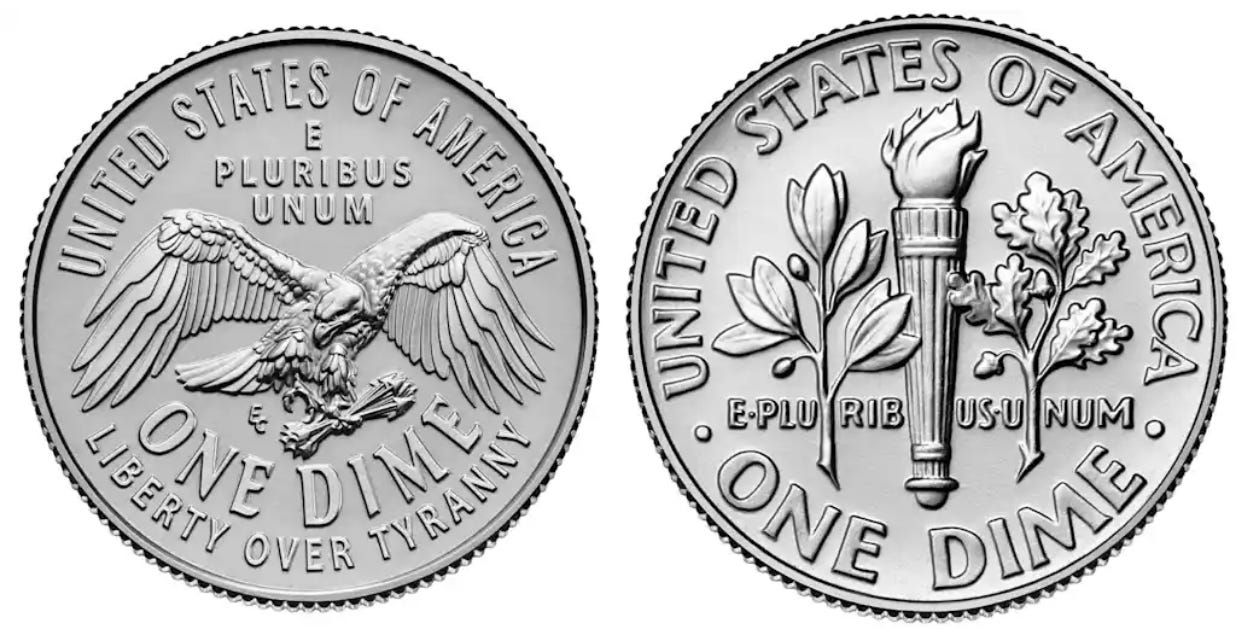
The new Emerging Liberty dime will temporarily replace the classic Roosevelt dime showing Franklin D. Roosevelt on one side and a torch, olive branch, and oak branch on the other side that represent liberty, peace, and strength. The Roosevelt dime will return in 2027.
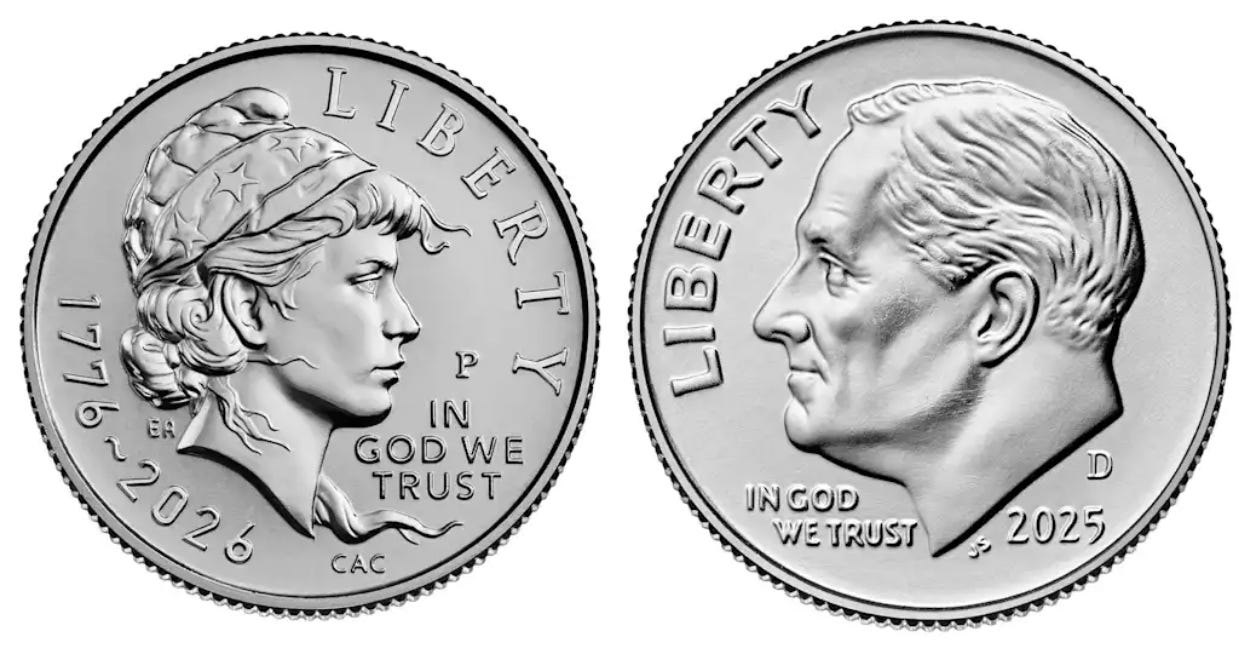
Critics say that the new dime design sends a pointed message, and given the administration’s track record, that’s a fair read of the situation. Trump hasn’t pursued a foreign policy of peace in his second term, despite campaign promises to do so. Still, he has been an effective marketer of the idea.
Trump used logos for initiatives like the so-called “Board of Peace” and “Shield of the Americas” summit, and after forcibly taking over the U.S. Institute of Peace last year, his State Department put his name on it. His push to rename the Department of Defense the Department of War is estimated to cost as much as $2 billion, and after after wearing a branded “USA” hat to the dignified transfer of six U.S. troops, his political action committee used a photo from the event in a fundraising email promising donors they’d get “private national security briefings.”
For its part, the Mint says the new dime was designed to symbolize the past, not the present. It said the eagle’s arrows represent “the American Revolution and the colonists’ fight for independence.” Eric David Custer, the Mint medallic artist who created the image, told WPSU Public Media that he left out the olive branches to represent the fact that colonists didn’t yet have peace at the time. The eagle’s talons are left open, though, to show that it’s waiting for peace, he said.
Custer’s past work includes designs for the 2022 Negro Leagues Baseball Commemorative Coin Program, 2023 American Women Quarters Program, and 2024 Harriet Tubman Commemorative Coin Program.
The Emerging Liberty dime is up against some tough optics, even with its intended meaning. Ditching the olive branch might be a story about the country’s founding, but doing so as the country embarks on a deeply unpopular war creates an irony that’s hard to ignore. The bald eagle on the Emerging Liberty dime might be waiting for peace, but in this moment, it seems primed for war.
This story was first published in Fast Company.
Have you seen this?
Somebody get this man some deodorant. Trump endorsed influencer Jake Paul for future office during an event in Kentucky last Wednesday where Paul appeared in a tan suit absolutely pitted out with the gnarliest pit stains I’ve ever seen. [Whig by Hunter Schwarz]
Traffic safety improvements frequently die by popular vote. It’s time to stop that. We don’t hold referendums on airplane safety. The same logic should apply to street design. [Fast Company]
Meryl Streep makes seven-figure donation to National Women’s History Museum. The museum has established the Meryl Streep Educator Award in honor of the actor’s gift. [Artnet News]
