

This story was first published on Sept. 20, 2022
Hello, from Yello, a newsletter about political aesthetics, persuasion, and design by Hunter Schwarz. Subscribe:
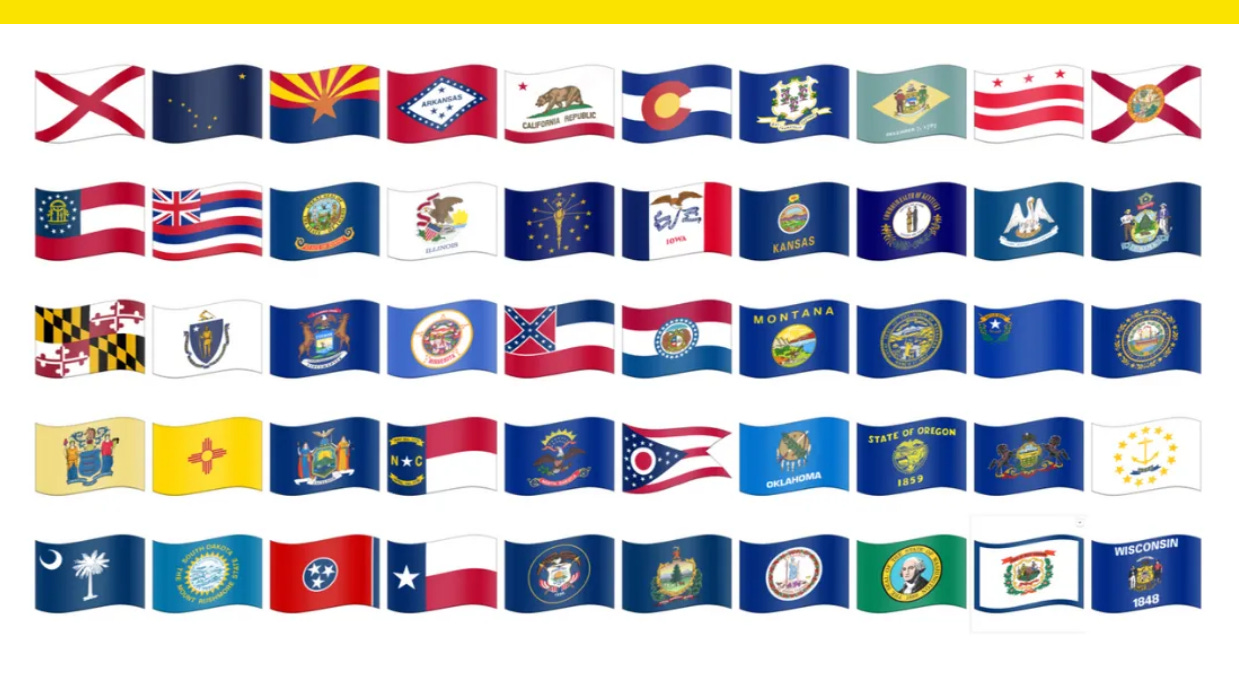
Sorry to everyone who wants state flag emoji, it’s not going to happen.
Today there are 258 flag emoji, the largest category, accounting for about 7% of all emoji. They’re also some of the least frequently used, and the Unicode Consortium, which approves new emoji, said it won’t accept any more new flag proposals.
Adding flags for every state, province, and other political subdivision would be a monumental task, because there are at least 3,681 subdivisions around the world as of 2017. That would more than double the emoji keyboard, which currently holds 3,633 emoji, but picking and choosing who gets a flag and who doesn’t is politically fraught.
“The Unicode Consortium isn’t in the business of determining what is a country and what isn’t,” Unicode Emoji subcommittee chair Jennifer Daniel wrote in a blog post about the decision.
There were originally just 10 flag emoji, for China, Germany, Spain, France, the U.K., Italy, Japan, South Korea, Russia, and the U.S. 🇨🇳 🇩🇪 🇪🇸 🇫🇷 🇬🇧 🇮🇹 🇯🇵 🇰🇷 🇷🇺 🇺🇸These early flag emoji were available on two Japanese phone carriers, and believed to be used to communicate cuisine, as in American or Chinese food, Daniel wrote.
The number of flag emoji eventually grew, though, and beginning in 2015, it seemed like U.S. state flags might have a shot at being added. That year, the consortium approved the red flag 🚩, checkered flag 🏁, and the flag of Antarctica designed by Graham Bartram 🇦🇶, followed in 2016 by the rainbow Pride flag 🏳️🌈 and the U.N. flag 🇺🇳.
In 2017, the consortium added its only subdivision flags, for three of the four nations of the U.K.: England 🏴, Scotland 🏴, and Wales 🏴. In the proposal for the emoji, the authors argued that these nations oftentimes compete in international sporting events using their nation flags rather than the U.K.’s Union Jack, and they were the only competitors to not have their own flags.
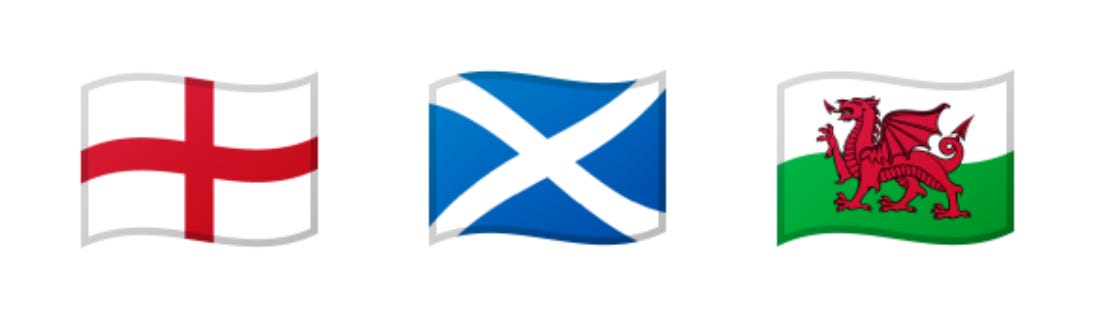
“The flags of England, Scotland, and Wales are some of the most prominent flags that don’t have emoji representation,” the authors wrote. “No other non-encoded flags see as frequent use in an international context in running text alongside other nation flags.”
While those three flags were approved, another proposal that year combined requests for flags for all 50 U.S. states, Northern Ireland, Catalonia and Basque Country in Spain, and Brittany in France, but none made the cut.
The final flag to be added came in 2020, with the pink, blue, and white transgender Pride flag 🏳️⚧️. Now, Daniel admitted, “adding a few flags seemed reasonable but in retrospect was short-sighted.”
“The inclusion of new flags will always continue to emphasize the exclusion of others,” she wrote. “They also tend to change over time! In the past six years since adding a Pride Flag to the Unicode Standard (2019) it’s already been redesigned. Many times. Identities are fluid and unstoppable which makes mapping them to a formal unchanging universal character set incompatible.”
The decision to stop adding new flag emoji is in line with the consortium’s general attitude towards adding fewer new emoji each year now. Rather than burdening keyboards with hyper-specific emoji that don’t get much use, they’re interested in versatile emoji that can be used to convey a broad range of concepts both literal and figurative.
The only way to add a new flag now, the consortium said, is for a country to get its own region code from the International Organization for Standardization, and that flag will be added automatically without the need for a proposal.
While U.S. state flags won’t be added by the Unicode Consortium, vendors are free to design their own flag emoji for states and other subdivisions. They would be visible on that specific platform, but won’t be universally supported and would look like a “missing flag” glyph on other platforms.


